Category
Website & Web services
Service
WEB SERVICES & API
What Is a Web API?
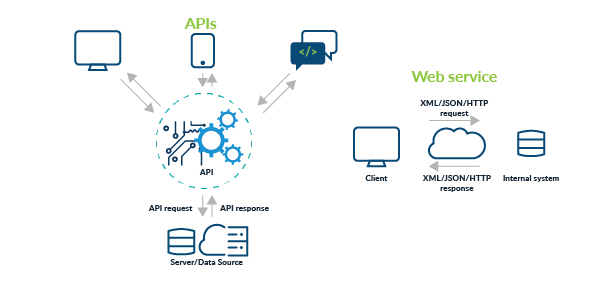
API stands for Application Programming Interface. This interface allows people to further build upon another application’s functionality and data. One might understand them as building blocks you can use to make almost anything as they can be found in everything from Spotify to Yahoo Finance.
The API frameworks allow developers to perform tasks that aren’t all that different from everyday events. For instance, think of giving an order to a server, that server putting your order in, and then bringing back the order when it’s ready. This step-by-step process returns the desired outcome: a tasty meal (in this case). A web-based example might be someone signing up to a new e-Commerce site by using their Facebook account.
A web-based example might be someone signing up to a new e-Commerce site by using their Facebook account.
Types of Web API
As of now, people use four distinct APIs.
- Composite APIs. These merge service and data APIs. The series of tasks operate synchronously due to execution and NOT due to task requests. These APIs can expedite the execution process, as well as improve web interface listening performance.
- Partner APIs. These require licenses or special rights for access as they are not generally available to public developers.
- Open APIs. In contrast, Open or “Public” APIs bear no access restrictions and can be accessed by the public.
- Internal APIs. As the name suggests, these operate as “Private” APIs within internal systems. They can be used among internal teams in a single company for service or product improvement.
Some APIs also require keys for authentication before allowing the mixture of information.
What Is a Web Service?
A web service, in contrast to an API, functions more like a resource that’s available using the internet. The network-based resource can be applied to specific tasks, but they require a network to function. This means that all web services are APIs, but only some APIs are web services.
A web service works by supporting interoperable machine-to-machine communication using a network. As such, web services tend to be connected with SOA or Service Oriented Architecture. This allows for different features to be separated then made available as various services within a network.
Types of Web Services
Industry veterans might recall when Windows Communication Foundation (WCF) replaced Microsoft web service technology from earlier. But the average web service framework can function in many different environments. Some popular options are:
- .NET Framework
- Apache Axis
- WSO2 WSF/PHP
- XML Interface for Network Services